
| |
 |
|

AWESOME NEW PRODUCT FROM JAMES HARDIE

(Above)
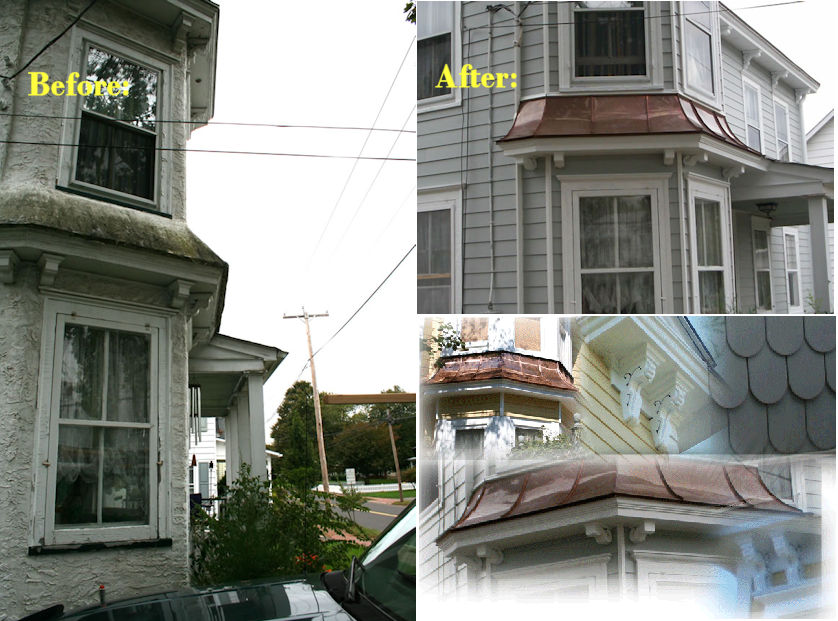
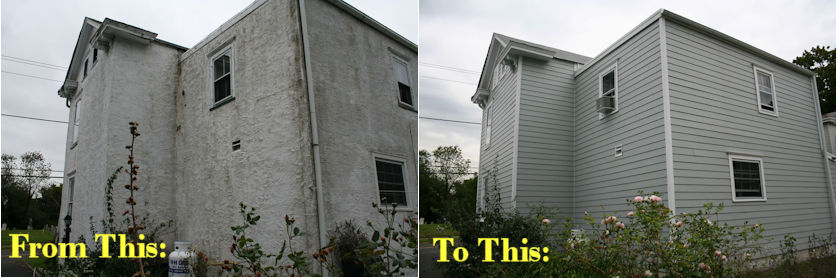
In the Federal Style reminiscent of the fledgling union forging
ahead with architectural statements of the Georgian
and Roman influences, along with the Adamesque
bays and curved copper roofs, we have restored
the exteriors of these quaint homes of old.
|
|
 |
| |
|
|
|
| |
|
 |
|
| |
|
|
| |
Get the Book
that picks up where this website leaves
off.....Click the Book Image above. |
|
Certainteed 2005 Award of
Excellence Winner!Click
Here to View Certainteed Award of Excellence
Primary
Protection: This is a must read to begin to
educate yourself as to the truth about most siding
installations today. There truly is a disconnect
between the faux siding industry and the realities
of devastation being created in its wake.
Security - FiberCement Siding is that Good!
Don't Forget to ask for your Homeowner's Insurance Discount
Vinyl Siding vs. James Hardie
Fiber Cement Siding is considered better than Brick
With just about everyone trying to cash in on the term "GREEN," we explore the meaning of "GREEN," with expert commentary. |
Recent
article from: http://www.askthebuilder.com/ "Cement
siding is a most interesting product. It has been
around for over 100 years, very much like cork flooring.
It gained widespread acceptance as many row houses
used it to resist "frost, fire & ants."
Those claims are so true! I know of 15 houses within
three miles that have it on the sides and roofs
of the houses. What is mind-boggling is that the
material has been in place since 1910 or so! The
houses that have it as siding show no signs of blistering
or peeling. If this isn't a reason for you to check
out all the manufacturers listed below, then I don't
know what is!
Based
upon research materials sent to me just before writing
this bulletin, one of the manufacturers clearly
leads the pack in volume. That company is the James
Hardie Building Products Company. Their U.S. capacity
is approximately 900 million square feet of siding
per year. Now mind you I didn't say that bigger
is necessarily the best. That kind of production
allows them to service demand." |
Product is
commonly known as 'hardie plank' and 'hardiplank'
or even hardyplank or hardy plank
"...made
of cement, sand and a small percentage of cellulose
fiber. . . . . . Reports from the field say that
it is performing well and, if installed carefully,
it's difficult to distinguish from wood. " — Joe Provey, "How to change the
skin — and appearance — on your home,"
Popular Mechanics.
|
|
|
|
|
|
|
|
|
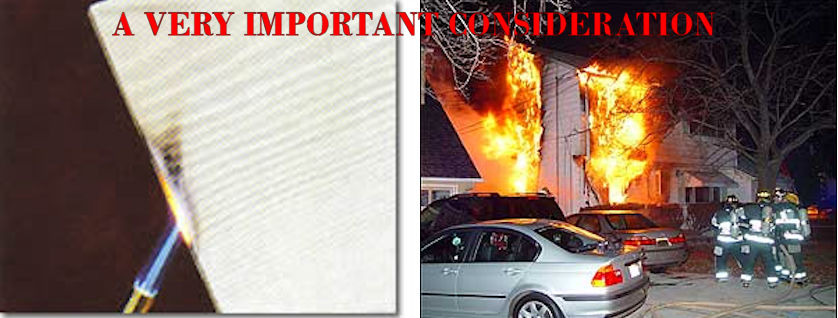
Unlike Vinyl Siding........
Fiber
Cement Siding
is Fire Resistant |
|

Much more than just Siding, appropriate accompaniments can really make your home shine.
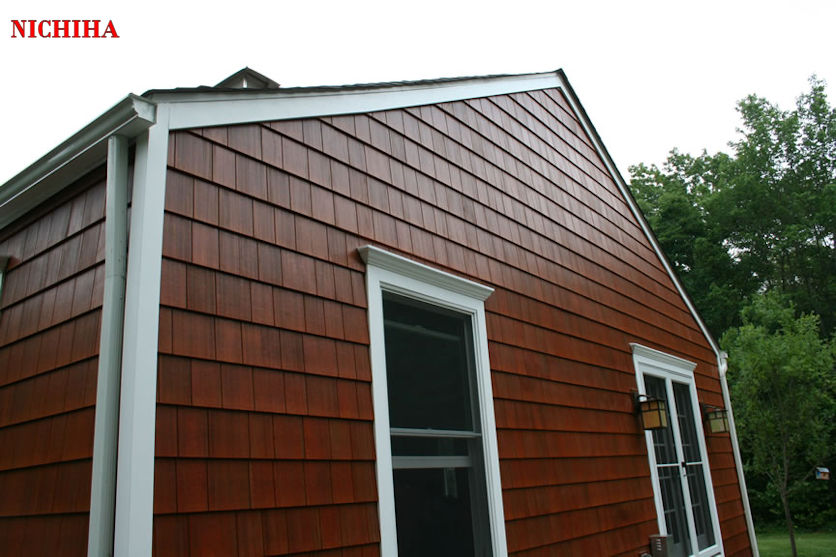
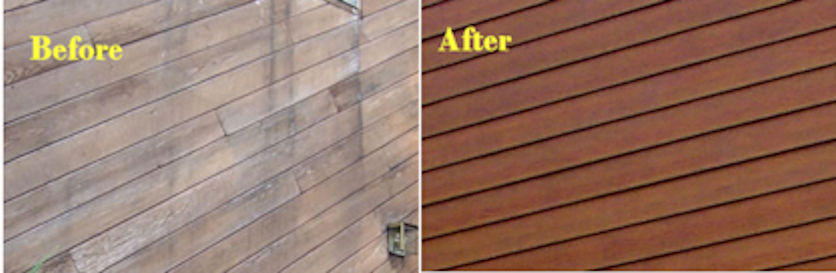
Wilmington, Delaware: Stained Fiber Cement Siding: An answer to New Growth Wood
|
LIFETIME CERAMIC FINISH
In
addition to the pragmatic reasons to choose these
siding products over anything on the market today,
are the absolute brilliance and richness of color
choices that are available. We will custom mix ANY COLOR! No other contractor offers our exclusive siding
product. It is truly "BULLETPROOF."
The
realistic profiles and grains and the tangible
formidability of a Hardie-sided home are breathtaking.
There really is no comparison to siding with Hardiplank.
We have attractive and affordable siding and trim
packages for your home’s transformation.
Call, or better yet, write (CLICK
HERE) today for a free evaluation.
|
|
|
|
| |
|
| Click
Here to view Video on how FiberCement Siding Saved
Homes from devastating Fire. |
| This
is a large file so it may take a moment to load... |
 |
| Example:
Damage from heat from house fire across
street melted vinyl siding on the second
floor..... |
|
|
| New Growth Wood is a problem and you will inevitably purchase it if you purchase exterior siding today. |
Wood &
Cedar Siding "...if wood were
just being discovered today, it would be heralded as a
miracle product. It takes a wide variety of finishes well,
offers some insulation value, is easy to repair and install,
and is available prestained, primed or unfinished in many
styles." — Joe Provey, "How
to change the skin — and appearance — on your
home," Popular Mechanics.
Wood
& Cedar Siding - History [the] Following building
methods developed in Norway and Sweden, board-&-batten
siding was often utilized to protect log structures from
weathering. It was used only on squared log structures
with dovetailed corner joints, or in Canada, on log piece
sur piece buildings such as those constructed by the Hudson's
Bay Company (HBC). This siding type was later used for
balloon- or western-framed structures. It was applied
directly to the structure on ancillary urban buildings
and on agricultural structures. On buildings intended
for human occupation, a layer of building paper was usually
attached to the frame before this siding was attached,
or there may have been an additional layer of rough sheathing
such as boards or shiplap.
Lap
Siding & Bevelled Lap Siding Among the earliest
types of finish siding, lap sidings were usually 1"
x 6" or 1" x 8" boards. These were nailed
along the top edge so that the nails were concealed by
the overlap of the board above. Exposed face-nailing in
vertical rows, however, is often evidence that lap siding
has been nailed directly to the studs, and the spacing
of the studs can thus be determined. The slope of the
boards was achieved by blocking out the bottom board and
using spacing blocks for the attachment of successive
boards. The exposed face and edges were usually planed.
Where more sophisticated milling tools were available,
the type of bevelled and rabbeted siding shown at the
top of the illustration became common.
Rusticated
Lap Siding Meant to replicate the rustic appearance
of logs sawn into rough boards, this siding, which was
called "Hide-a-Scroll," was actually milled
with a slightly chamfered edge. It was very popular in
the 1960s. Drop Siding This form of milled siding became
generally popular all over North America during the nineteenth
century. If wider than 6', a face nail was used, as well
as a nail concealed in the rabbet, to avoid "cupping"
of the board as it seasoned.
Bevelled Lap Siding with V-Groove (V-Joint) Usually
milled from a 1" x 6". Each board was rabbeted
on reverse edges at top and bottom, with V-grooves on
the face. When attached, the lap protects the board below
from water penetration, and the groove defines the joint.
An intermediate "false" V-groove was usually
milled in the centre of the board (also called "double-bevelled"
siding). With time, the boards shrank, and the "false"
and real joints became distinguishable as the latter became
wider. The example illustrated has a "bead"
milled between two V-grooves at each joint. This siding
was usually face-nailed. Sawn Shingles Sawn shingles were
milled with a taper and have always varied in grade and
quality. In BC, the wood utilized was first-growth red
cedar. Attachment and staggering was done the same way
as with shakes. Some of the patterns were: • Common Coursing The width of the course or "weather"
varied with the length of the shingle. •Shadow-Line Coursing This is achieved by doubling
each course, setting the outside shingle below the inside
shingle, to create the shadow. This pattern, which was
common during the 1920s and 1930s, also often employed
shingles milled with vertical grooves.
•
Unequal Coursing Commonly associated with the North American
Arts and Crafts style, this pattern was achieved by alternating
a narrow and a wide course.
Sawn
Shingle Patterns & Hand-Split Shakes Sawn Shingles These utilize shingles cut at the bottom, either in a
semi-circle or a 45-degree V, and could produce fish-scale
or diamond patterns, either used independently or combined...
•Hand-Split Shakes Shakes were split by hand from
red cedar or spruce blocks with a mallet and froe, and
sometimes tapered with a draw-knife. Vertical joints were
staggered, and the nails were usually covered by the lap
of the next course of shakes. When used on roofs, courses
of shakes were often doubled. — www.islandnet.com |
|
Aluminum
Siding "...The main advantages of
aluminum siding include its longevity and low maintenance.
It doesn't change much over time and it is finished with
coatings that are formulated for toughness and long-term
durability." Siding, Quick facts center ( popular mechanics.com)
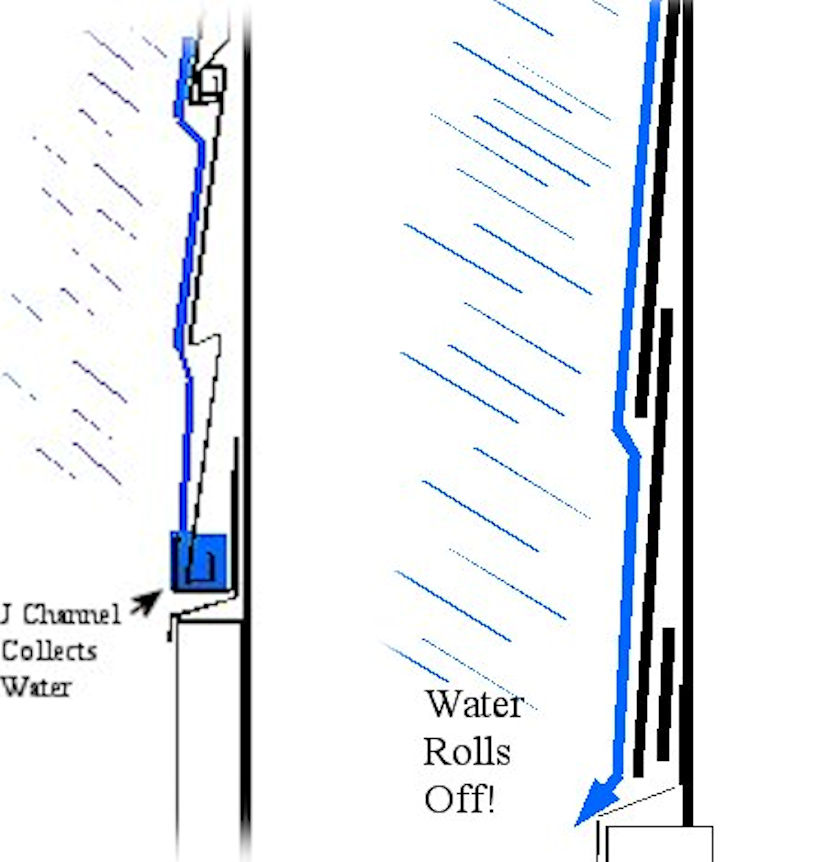
Why
the use of 'J' Channel causes siding leaks...
It is imperative that
you engage the services of seasoned craftsmen that know
their trade.
Vinyl
Siding In recent years, vinyl has become the siding
market leader. It's made from polyvinyl chloride (PVC),
the same stuff that serves so ably in plumbing drain lines.
Certainly its primary appeal is that it doesn't have to
be painted. If properly installed, the upkeep is minimal.
But, its popularity continues to grow because of new product
offerings and features such as wood-like textures, shingle-
and shake-style panels, more appealing trim components
and deeper colors. According to the Vinyl Siding Institute,
shipments have more than tripled since 1986. Vinyl's biggest
selling point remains its low maintenance. It usually
can be washed clean with a garden hose. Material and installation
costs are relatively low too. — Joe Provey,
"How to change the skin — and appearance —
on your home," Popular Mechanics.

History
of Vinyl Siding PVC was first produced in a laboratory
in 1872. In the 1930s, vinyl siding began to be produced
commercially. Techniques for mixing it with plasticizers
became known and PVC emerged as a substitute for rubber.
During World War II, German scientists developed PVC pipe
for water supply systems when material shortages limited
conventional pipe supplies... ...Today the North American
PVC market is dominated by about a dozen large manufacturers.
A few of these, such as Occidental Petroleum, Inc., operate
facilities for all phases of the process, from chlorine
and ethylene production to end products. Most, however,
purchase some of the refined materials from other producers.
Dow Chemical Company produces large quantities of vinyl
chloride for sale to other companies but produces no PVC
itself. Vinyl siding was introduced in the early 1960s,
but did not gain much attention until the 70s. Since 1986,
its use has doubled, reaching 2.2 billion square feet
in 1992. Siding is the second largest market for PVC resin,
with 1 billion pounds used in 1992 by about about 20 manufacturers.
While vinyl siding was initially sold almost exclusively
for remodeling, today more than a third of vinyl siding
is used in new construction. Vinyl siding is manufactured
by coextrusion: two layers of PVC are laid down in a continuous
extrusion process. The top layer (weatherable capstock),
includes about 10% titanium dioxide, which is a pigment and provides resistance to breakdown from UV light. The
lower layer (substrate) is typically about 15% calcium
carbonate, which balances the titanium dioxide to keep
both extrusion streams equally fluid during manufacturing.
A small quantity of tin mercaptan or butadiene (less than
1%) is added as a stabilizer to chemically tie up any
hydrochloric acid that is released into the PVC material
as the siding ages. Lubricants are also added to aid in
the manufacturing process. — Nadav Malin, Alex
Wilson, www.buildinggreen.com
|
 |
|
| CONTACT
US |
AWARD
OF EXCELLENCE |
COLORVIEW |
VENTILATION |
MOISTURE |
We
won't leave you waiting around. Our estimators are
on the road Mon - Sat, so feel free to request a
no-hassle estimate. |
WINNER!
Press Release for 2005 award winner for the inovative
use of Certainteed Weatherboards Fiber Cement Siding |
will
help you to decide upon product selections, colors,
and styles of exterior products. |
Please
read about our unique approach to a truly misunderstood
issue. |
Please
read our experiences in homes with condensation,
mold, frost, ruined insulation, etc. |
| ICE
AND WATER SHIELD |
TYPES
OF SIDING |
WINDOWS |
GUTTER
SCREEN AND LEAF GUARDS |
| BACK
TO FSI HOME |
Please
read our strong feelings about the misuse of these
super quality underlayments. |
...A
little history of the current types in use. |
Quality
varies and an informed consumer is our best customer. |
....From
a roofing perspective... |
| FIBERGLASS
ROOFING SHINGLES |
|
| A little
history, unique characteristics. |
|
|
| This website recieves 20,000 hits a day thanks to: SerpeoSEO - Philadelphia Website Design, Seo & Marketing |
| |
| |

|
|
|
|
|
|
|
|
|
|