

Phantom Leaks
When Siding Installations Seem To Leak…… Some Siding allows water to enter behind ...a must read
Many cases of “Siding Leaks” are not as they may seem. Many times interior moisture migrates through the wall and at the dew point condensation occurs. This cooling of warm air will always result in the dropping of moisture. As your breath fogs on the cold windshield of an automobile in the winter, this condensing of air compresses the molecules closer together, squeezing the air like a sponge.
The newer homes have efficient windows and doors, very well insulated walls, but where the air is allowed to migrate toward the colder exterior, condensation will occur. This happens in the bathroom after a shower and on the kitchen walls while cooking.
It is the allowance of moisture laden air to travel within a warm space toward the colder exterior, in the winter, which causes the major problems.
MOLD BEHIND SIDING CAUSED BY INTERIOR MOISTURE - MOLD INSIDE WALLS!
Mold in the Attic needs to be addressed.
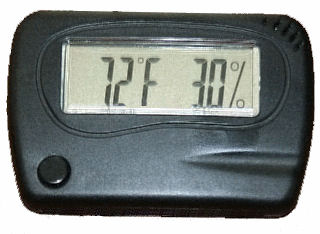
Start with the cause, moisture. Measure your indoor relative humidity.
Inside the walls and usually near windows and wherever there are areas that air can travel, moisture goes with it. The interior pressures of most residential dwellings in the Northeast are tremendous in the winter months. Warm air pushes right through walls to that point where the cold meets the warmth and moisture condenses. If you are experiencing unexplained water intrusion behind your siding, perform professional leak detection services to isolate the moisture source before replacing wall assemblies.
When the resulting problems show themselves, homeowners are all too often sold a "tighter job" with house wraps and weather barriers, etc. behind their new siding jobs. Little do they realize that the cycle is about to return with a vengeance, because their problems have been accentuated by the new and tighter barrier on the outside of their homes.
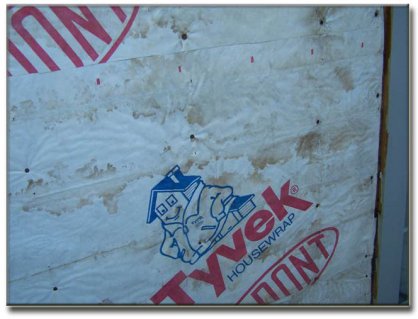
These barriers and house-wraps are sold as "breathable" and water vapor is supposed to be able to pass through. The problem occurs when the cold temperatures condense the air and moisture becomes trapped behind the barrier. Take a look at what most people would call a siding leak in the photograph below. The moisture came from within the wall! The site conditions along with the barrier caused the condensation! House-wraps are not breathable in the winter! If you do not believe it, please visualize the following:
(The following procedure does not have to be done to visualize the results. Please be careful if you do this)
Open a window with a screen closed.
Carefully set the pot on the window sill and support it so as not to spill.
Watch the moisture migrate to the outside in the form of vapor.
On the screen, which is a thousand times more "breathable" than any House-wrap, water will be streaming on the inside as the warm air that is holding the vapor condenses.
Solution:
- Do not look to house wraps as a solution to your "Siding Leaks."
- Have the moisture content of the interior of your home tested. 40% is considered normal. A digital hygrometer can be obtained on the internet, or at your favorite cigar store.
- Check for wet basement problems. Find out if your crawlspace or basement has a vapor barrier.
- The doormat test is a good one. By the book, a 12" x 12" piece of plastic is taped to the floor of the crawlspace or basement for a day or two and when removed, if moisture can be observed, your slab or floor does not have a proper vapor barrier. A doormat works just fine and it is a little bigger. Skip the tape.
- Check your heating system for overactive humidifier.
- Pull the interior trim on the windows of your home and insulate window frames and tape off gaps at rough openings. Paint interior with enamel paint that forms vapor barrier.
- In the Northeastern climate, Vapor Barriers should be installed on the inside, warm side of the wall, where water vapor remains airborne and in a gas state in the winter months. Although conditions are many times reversed in the summer months, the pressures from the outside never rival those from within during the winter months.
- Take heed and make sure you are not spending your home improvement dollars on measures that will make your problems worse.
Useful & Informative Links:
Moisture Mechanics / Thermal Insulation Materials and Symptoms / Conceptual Reference Database for Building Envelope Research / Condensation and Evaporation / Moisture in buildings / Dampness in Buildings: Diagnosis, Treatment, Instruments
Other pages that may be of interest:
Windows, PHANTOM LEAKS, and the Big Box Stores
Siding Myth #1 Shattered: Siding Itself Is Not Energy Efficient
We have the seasoned craftsmen that mentor our journeymen to maturity in their trades.
The best siding for your home.. and the best people to do it for you.